
VMProtect vs Themida vs ChaosProtector: 2026 Comparison
VMProtect vs Themida: The Short Answer
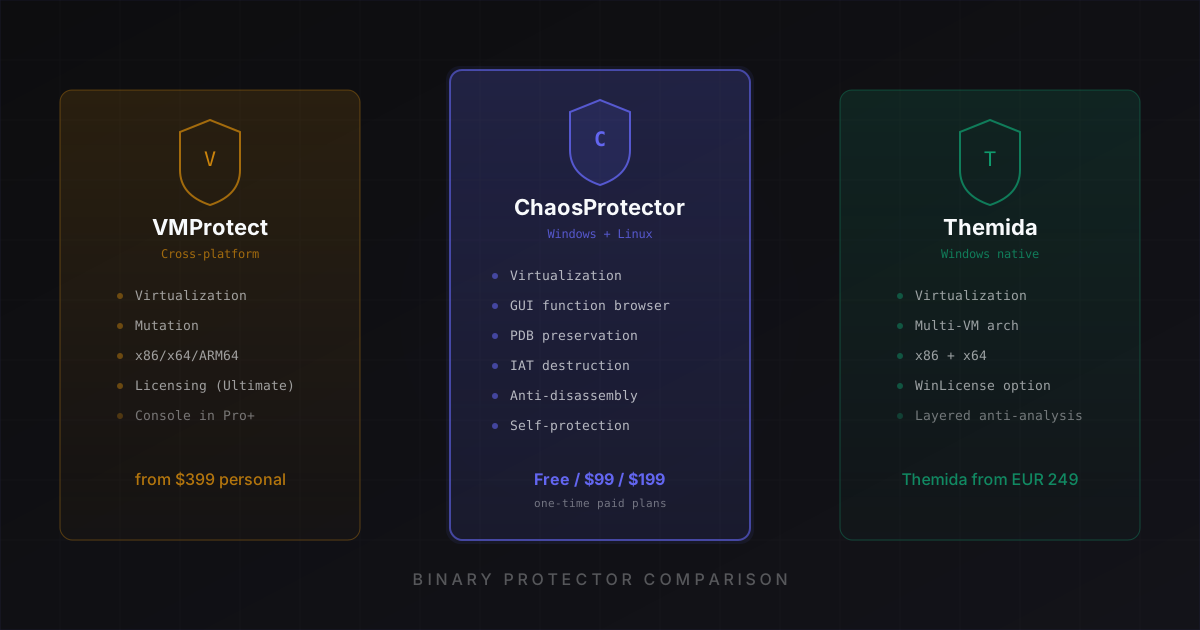
VMProtect and Themida are established commercial protectors, but they are not identical products. VMProtect covers a broad set of platforms and architectures, with application licensing available in its Ultimate edition. Themida focuses on native Windows protection; Oreans offers WinLicense when licensing, trials, and activation management are also required.
ChaosProtector takes a different position: a Windows-focused visual and command-line workflow for native binaries, separate managed-code protection, Godot-specific protection, and native Linux ELF64 support. It includes a free plan and lower-priced paid tiers, while VMProtect and WinLicense offer more established, integrated licensing ecosystems for developers distributing their own software.
There is no universal winner. The right choice depends on the binaries you ship, whether you need a licensing SDK, how much automation you require, and how each protector behaves with your actual application.
Disclosure and review date: This comparison is published by the ChaosProtector team and was last reviewed on August 9, 2026. Competitor capabilities and prices are taken from their official product, documentation, and pricing pages. Verify current terms with each vendor before purchasing. No protector can make software impossible to analyze; these tools are designed to increase the time and expertise required.
What to Compare Before Choosing a Protector
A feature count alone is not enough. Evaluate these questions first:
- Target formats and platforms: Windows PE, .NET, Linux ELF, macOS, Android, drivers, or game assets may require different products or editions.
- Protection method: Code virtualization, mutation, packing, string protection, import protection, anti-debugging, and integrity checks solve different problems.
- Application licensing: If you need to issue serials, activate customers, enforce trials, or manage floating licenses, confirm that the required system is included in the edition you buy.
- Workflow and automation: Check how functions are selected, which debug symbols are supported, and whether a CLI is available in the relevant tier.
- Compatibility: Measure startup time, protected-function performance, binary size, crash reporting, antivirus behavior, and update reliability on your own release build.
- License terms and updates: Compare individual and company licenses, supported use cases, update periods, and renewal terms rather than looking only at the entry price.
For background on the core technique, read what code virtualization does and why it should normally be applied only to selected sensitive functions.
VMProtect in 2026
VMProtect combines code virtualization and mutation with options such as memory protection, import protection, packing, debugger detection, and virtual-environment detection. Its official documentation lists support for x86, x86-64, ARM64, and .NET targets across Windows, Linux, macOS, and Android.
VMProtect is sold in three editions:
- Lite includes virtualization, mutation, memory protection, import protection, and packing.
- Professional adds the advanced interface, scripts, watermarks, and console version.
- Ultimate adds the licensing system, activation features, and virtual files for Windows binaries.
At the time of this review, the official individual prices displayed were $399 for Lite, $599 for Professional, and $999 for Ultimate, each with one year of updates. Company licensing was priced separately. See the official VMProtect edition and pricing page and VMProtect documentation for current details.
VMProtect is a strong candidate when broad platform coverage, multiple architectures, an established workflow, or an integrated licensing system in the highest edition is central to the project.
Themida and WinLicense in 2026
Themida is Oreans Technologies' native Windows protection product for x86 and x64 executables and DLLs. Oreans lists code virtualization, code mutation, runtime string encryption, anti-debugging, API wrapping, whole-application encryption and compression, integrity checks, and startup protection checks among its capabilities.
Themida itself is the protection product. WinLicense combines that protection engine with trial and registration features, hardware locking, floating licenses, and a license manager. This distinction matters when comparing Themida with VMProtect Ultimate: developers who need customer licensing should compare VMProtect Ultimate with WinLicense, not with Themida alone.
At the time of review, Oreans' official comparison page displayed Themida from EUR 249 and WinLicense from EUR 399. Code Virtualizer, a separate Oreans product with broader platform scope but a narrower feature set, was listed from EUR 199. Check the official Oreans product comparison for current features, prices, and editions.
Themida is a strong candidate for native Windows projects that want a mature, layered protection product. WinLicense is the relevant option when the same project also needs integrated trials and customer licensing.
How ChaosProtector Fits
ChaosProtector 2.8.0 is designed around selective protection and a workflow that can be used interactively or in build automation. Its native engine supports Windows PE32 and PE32+ executables and DLLs, Windows kernel drivers, Microsoft Visual C++ builds, and CLion/MinGW-w64 builds. Native Linux ELF64 protection, managed-code protection, and a dedicated Godot workflow are also available in the product family.
Relevant workflow features include:
- A GUI function browser plus a CLI for scripted builds
- PDB, COFF, and MAP symbol discovery for selecting functions by name
- Selective native code virtualization and obfuscation
- String encryption, import protection, anti-debugging, integrity checks, and anti-analysis layers
- Optional preservation of an existing input PDB beside the protected output
- Godot PCK and executable protection for teams shipping Godot games
ChaosProtector does not position itself as an application licensing and activation suite comparable to VMProtect Ultimate or WinLicense. If issuing customer licenses is a core requirement, include a separate licensing system in the architecture or choose a protector edition that provides one.
The current plans are Free, Basic at $99, and Pro at $199. Basic and Pro are one-time purchases with one year of updates and support; the purchased version remains usable after that update period. Because features vary by plan, review the current ChaosProtector pricing and feature matrix.
If the workflow sounds suitable, start with the Free plan on a representative release binary before purchasing. The documentation includes CLI examples for repeatable testing and CI/CD integration.
Feature and Product-Scope Comparison
The table below summarizes product scope rather than claiming equivalent implementations. A checkmark would hide important edition and workflow differences, so the entries describe what each vendor currently documents.
| Area | ChaosProtector | VMProtect | Themida / WinLicense |
|---|---|---|---|
| Core protection | Selective virtualization, obfuscation, and layered anti-analysis features | Virtualization, mutation, combined modes, packing, and layered protection | Virtualization, mutation, encryption/compression, and layered protection |
| Native target scope | Windows x86/x64 PE, drivers, and Linux ELF64 | x86/x64/ARM64 across Windows, Linux, macOS, and Android | Themida/WinLicense: native Windows x86/x64; Oreans Code Virtualizer has broader platform scope |
| Managed-code option | Separate managed-code protection is included in the product family | .NET support is documented | Confirm the required managed workflow with Oreans |
| Function-selection workflow | GUI browser and CLI using PDB, COFF, or MAP symbols | GUI; advanced interface and console depend on edition | GUI-centered workflow; verify automation requirements with Oreans |
| Developer licensing and trials | No integrated customer licensing suite comparable to the other products | Licensing and activation in Ultimate | WinLicense adds licensing, trials, hardware locks, and floating licenses |
| Evaluation path | Free plan | Downloadable demo | Downloadable Themida and WinLicense demos |
| Price snapshot, August 2026 | Free; Basic $99; Pro $199 | Individual Lite $399; Professional $599; Ultimate $999 | Themida from EUR 249; WinLicense from EUR 399 |
Prices are snapshots, exclude plan-specific details, and may change. Use the linked official pages for purchasing decisions.
Which Binary Protector Should You Choose?
Choose VMProtect when
- You ship across several operating systems or need ARM64 support.
- You want an established product with multiple protection modes.
- You need VMProtect's licensing and activation system and are comfortable with the Ultimate edition.
- Your automation requirements match the Professional or Ultimate toolset.
Choose Themida or WinLicense when
- Your primary target is a native Windows x86 or x64 application.
- You want the SecureEngine protection layers documented by Oreans.
- You need integrated trial and registration management, in which case WinLicense is the product to evaluate.
Choose ChaosProtector when
- You want to browse and select native functions through a modern GUI or automate the same workflow through a CLI.
- Your Windows builds use MSVC or MinGW-w64 and symbol-assisted selection matters.
- Existing-PDB preservation, Godot-specific protection, or the Linux ELF64 workflow fits your release process.
- You want to test a free tier before deciding whether the $99 Basic or $199 Pro plan is justified.
These are starting points, not security guarantees. Build a small evaluation matrix and protect the same sensitive functions with each candidate. Then compare correctness, performance, file size, diagnostics, antivirus results, and the effort required to reproduce the configuration in CI.
Our guide to protecting an EXE from reverse engineering provides a practical checklist you can reuse during that evaluation.
Frequently Asked Questions
Is Themida better than VMProtect?
Not in every situation. Themida is focused on native Windows protection, while VMProtect documents broader platform and architecture support. If application licensing is required, compare WinLicense with VMProtect Ultimate and test both on the actual software you ship.
Does VMProtect or Themida make an application uncrackable?
No. The same is true of ChaosProtector. Binary protection can increase analysis cost and discourage opportunistic attacks, but a determined specialist with enough time may still understand or modify client-side code. Keep secrets and decisive authorization checks on a server whenever possible.
Which option includes customer licensing?
VMProtect Ultimate includes licensing and activation features. WinLicense adds licensing, trial, hardware-locking, and floating-license features to Oreans' protection engine. ChaosProtector is currently focused on binary and asset protection rather than providing an equivalent customer-licensing platform.
Can I test the tools before purchasing?
Yes. VMProtect and Oreans publish demos, while ChaosProtector offers a Free plan. Test a representative signed release build, not just a small sample executable, and repeat your normal QA and antivirus checks after protection.
A Practical Next Step
If ChaosProtector is on your shortlist, download the Free plan and protect a non-performance-critical function in a copy of your release binary. Verify behavior, crash diagnostics, file size, and deployment tooling first. If the result meets your requirements, compare Basic and Pro before upgrading.
Ready to protect your software?
Download ChaosProtector for free and start protecting your binaries in minutes.
Download Free