
Code Virtualization: How It Protects Windows Software
The Problem: Your Compiled Code Is an Open Book
When you compile a C++ or Rust program into a Windows executable, the result is native x86-64 machine code. This code is well-documented, well-understood, and supported by decades of reverse engineering tooling. Tools like IDA Pro, Ghidra, and x64dbg can disassemble your binary back into readable assembly in seconds.
For many developers, this is fine. But if your software contains proprietary algorithms, license validation logic, or trade secrets embedded in code, native machine instructions offer almost no resistance to a determined reverse engineer.
This is where code virtualization comes in.
How Code Virtualization Works
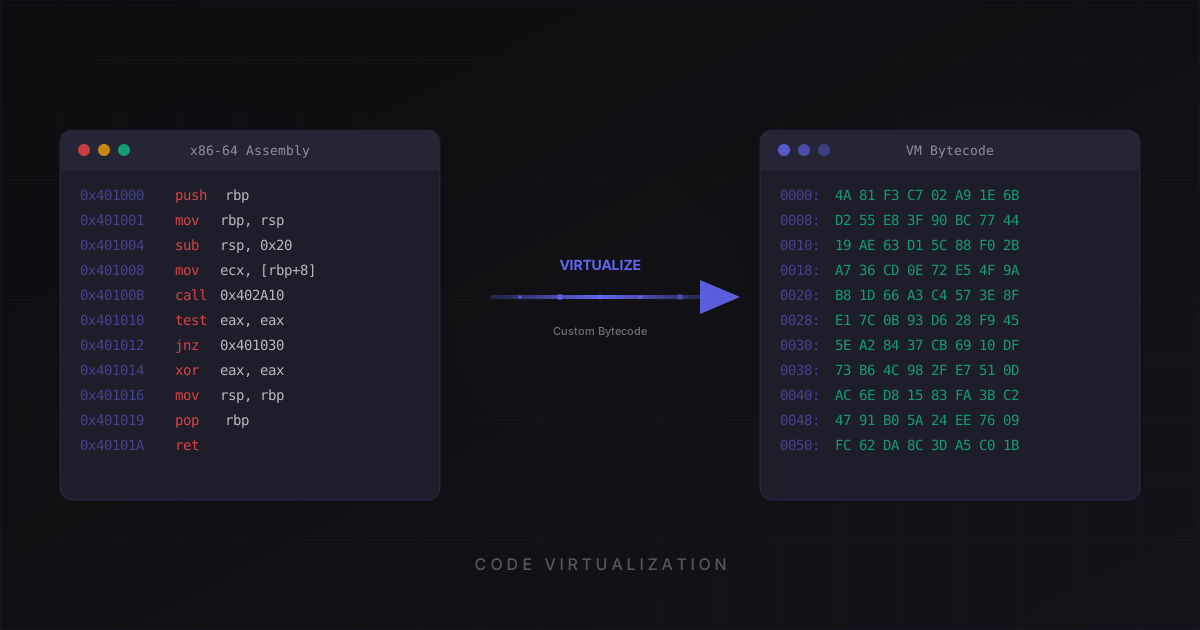
Code virtualization transforms selected functions in your executable from native x86-64 instructions into a custom bytecode format that only an embedded virtual machine interpreter can execute.
Here is what happens at a high level:
- Translation: The protector analyzes your native x86-64 instructions and converts them into a proprietary bytecode instruction set.
- Embedding: A custom VM interpreter is compiled and injected into your executable.
- Replacement: The original native code is removed and replaced with a stub that invokes the embedded VM, passing it the translated bytecode.
- Execution: At runtime, the VM interpreter reads the custom bytecode and executes the equivalent operations, producing the same results as the original code.
The key insight is that the bytecode format and the interpreter's dispatch logic are unique to each protection pass. An attacker cannot simply grab a generic disassembler and read the virtualized code. They would need to reverse engineer the VM interpreter itself, understand its opcode table, and then write a custom lifter to translate the bytecode back into something readable.
This can raise the cost of analysis substantially, but it is not a guarantee. A specialist can still trace the interpreter, recover bytecode, model handlers, or build a devirtualization workflow. The practical result depends on VM diversity, handler design, protected-function size, and how much information the surrounding native code reveals.
How Virtualization Compares to Other Protection Methods
There are several approaches to protecting a compiled binary. Each operates at a different level and provides a different strength of protection.
Obfuscation transforms native code to make it harder to read while preserving the original instruction set. Techniques include junk code insertion, control flow flattening, and opaque predicates. The code is still x86-64, so standard tools still work. It slows attackers down, but a skilled reverser can work through it.
Packing compresses or encrypts the entire executable and unpacks it into memory at runtime. This defeats static analysis, but once the program is running, a reverser can dump the unpacked binary from memory and analyze it normally. Packing is a speed bump, not a wall.
Encryption of individual code sections works similarly to packing. The code is decrypted at runtime and then executes as normal native instructions. Memory dumping bypasses this entirely.
Code virtualization is fundamentally different from all three. The original native instruction sequence is replaced by bytecode and an interpreter. The original function is therefore not directly available for a conventional native-code disassembler, although the interpreter, bytecode, runtime state, and surrounding native code can still be inspected by a determined analyst.
This is why virtualization is commonly used as a high-resistance layer for selected compiled functions rather than as a claim that analysis is impossible. For a product-level comparison of how commercial tools package this technique, see VMProtect vs Themida vs ChaosProtector.
What Makes a Good Virtualizer
Not all virtualizers are created equal. The strength of the protection depends on several factors:
- Opcode randomization: Each protection pass should generate a different bytecode encoding, so static analysis of one protected binary does not help with another.
- Handler complexity: The VM handlers (the code that implements each virtual opcode) should themselves be obfuscated and difficult to isolate.
- Selective application: Virtualizing an entire binary causes severe performance overhead. A good tool lets you choose exactly which functions to virtualize -- typically license checks, cryptographic routines, and proprietary algorithms.
- Compatibility: The protection must not break the executable. Proper handling of stack frames, exception handling, relocations, and calling conventions is essential.
The Trade-Off: Performance
Virtualized code is slower than native code. Every original instruction is now interpreted through a dispatch loop. The overhead varies, but 10x to 50x slowdowns on virtualized functions are common.
This is why selective protection matters. You do not virtualize your main rendering loop or a hot inner loop processing millions of records. You virtualize the functions that contain your intellectual property: the algorithm that gives your product its edge, the license validation that gates access, the anti-tamper checks that detect modification.
Applied selectively, the performance impact can often be confined to functions that are not latency-critical while still protecting sensitive logic.
The correct selection is application-specific. Benchmark protected and unprotected builds on representative customer hardware, including startup, hot paths, crash handling, and update flows.
When Should You Use Code Virtualization?
Code virtualization makes sense when:
- Your software contains proprietary algorithms worth protecting
- You ship license validation logic inside the binary
- You are in a market where cracking and piracy directly impact revenue
- You need protection that goes beyond what obfuscation alone can provide
It is not necessary for open-source projects, server-side code that users never receive, or applications where the business value is not in the code itself.
Getting Started
ChaosProtector provides code virtualization for Windows 32-bit (x86) and 64-bit (x86-64) executables with a GUI that lets you browse functions and select which ones to virtualize. The same selection can be automated through the CLI. Combined with import protection, anti-disassembly, and runtime checks, it provides several layers that can be tested independently.
Start with a copy of a representative release binary and protect one non-performance-critical function. Download the Free plan, follow the CLI documentation, and verify behavior before enabling more layers. Code virtualization is included in the paid plans; compare Basic and Pro only after the evaluation build passes your normal QA.
Ready to protect your software?
Download ChaosProtector for free and start protecting your binaries in minutes.
Download Free