
Protecting Linux ELF Binaries from Reverse Engineering in 2026
The Linux Binary Protection Gap
Everyone who ships commercial software on Linux has hit the same wall: there is almost no tooling for protecting Linux binaries the way legacy protectors and ChaosProtector protect Windows PE files.
This is not because Linux binaries don't need protection. If anything, they need it more. The Linux reverse engineering toolchain is more mature, more free, and more widely distributed than the Windows one. Every developer who has ever compiled a C program has gdb, objdump, nm, strings, and readelf sitting in their package manager. Ghidra runs on Linux natively. radare2 was written on Linux. IDA Pro has a Linux build.
The gap exists because historically, commercial software ran on Windows, and Linux was for servers and developers. That has changed. Game studios ship Linux native builds on Steam. SaaS vendors run proprietary agents on customer Kubernetes clusters. Trading firms deploy low-latency binaries to Linux colocation. Industrial controllers run on embedded Linux. Every one of these scenarios involves a compiled binary the vendor does not want reverse engineered.
And most of them are shipping strip'd binaries with no protection at all.
Why Linux ELF Is Easier to Reverse Engineer Than Windows PE
The ELF format was designed for transparency and interoperability. That is exactly the opposite of what a protector wants.
1. Symbol tables leak everything by default. Unless you pass -s to the linker or run strip --all, your binary ships with .symtab and .strtab, which name every function, global variable, and type. Ghidra imports these in under a second and you are staring at a source-code-equivalent function list. Even stripped binaries keep .dynsym (exported symbols) for dynamic linking, so all your exported API entry points are always visible.
2. Debug information is tempting and often accidental. DWARF debug sections (.debug_info, .debug_line, .debug_str) can slip into release builds when developers forget -g0 or when CI pipelines copy unstripped binaries. A single DWARF section and Ghidra will reconstruct your original source filenames, function signatures, local variable names, and struct layouts. This is effectively a decompilation shortcut that bypasses weeks of analysis.
3. Dynamic linking is fully documented. Every library call your binary makes goes through the PLT (Procedure Linkage Table) and GOT (Global Offset Table), both of which are standard, public, and indexed by symbol name. objdump -R mybin prints every external function your binary imports, with names. Compare this to Windows IAT destruction, where protectors like ChaosProtector encrypt the import table and resolve symbols at runtime via PEB walks. On Linux, without deliberate protection, the import map is an open book.
4. The Linux reverse engineering toolkit is superior. Ghidra (free, from the NSA), radare2 (free, open source), IDA Pro (commercial, runs on Linux), gdb with python scripting, ltrace for library call tracing, strace for syscalls, LD_PRELOAD for hooking any libc function without touching the binary. The typical Windows reverser uses IDA + x64dbg. The typical Linux reverser has ten tools and knows them all.
5. No anti-debug platform. Windows has rich anti-debugging APIs like IsDebuggerPresent, NtQueryInformationProcess, CheckRemoteDebuggerPresent, and PEB flags. Linux has exactly one: a ptrace self-attach check. Once a reverser has patched that single check out of your binary, they can debug freely.
What strip and UPX Actually Do (Spoiler: Not Much)
These are the two things developers reach for when they want to "protect" a Linux binary.
strip --all mybin removes the non-essential symbol tables and debug sections. This helps against casual analysis because Ghidra can no longer give every function a nice name. But it is not protection:
- Stripped binaries still have
.dynsym(exported symbols) because dynamic linking requires them. - Stripped binaries still have the PLT, which is trivially cross-referenced with the dynamic linker's view of imports.
- Ghidra 11+ runs its function identification pass even on stripped binaries and recovers most function boundaries.
- Strings in
.rodataare untouched — your error messages, SQL queries, and license check prompts are still greppable in 200 ms.
UPX packs your binary into a self-unpacking stub. It reduces file size and defeats the laziest form of static analysis (strings mybin returns nothing useful). But:
- UPX is a public tool with a documented format. The command
upx -d mybinunpacks it. Done. - Even without
upx -d, dumping the unpacked binary from memory at runtime is a standard operation that takes under a minute with any debugger. - The UPX unpacking stub itself is a well-known signature that AV engines flag. You will get false positives without gaining any real protection.
Strip plus UPX can slow casual inspection, but neither provides a measurable secrecy guarantee. Treat them as packaging or a speed bump, not as an authorization boundary.
What Real Linux Binary Protection Looks Like
Actual protection of an ELF binary needs the same techniques that Windows PE protectors have used for twenty years, adapted to the Linux runtime model.
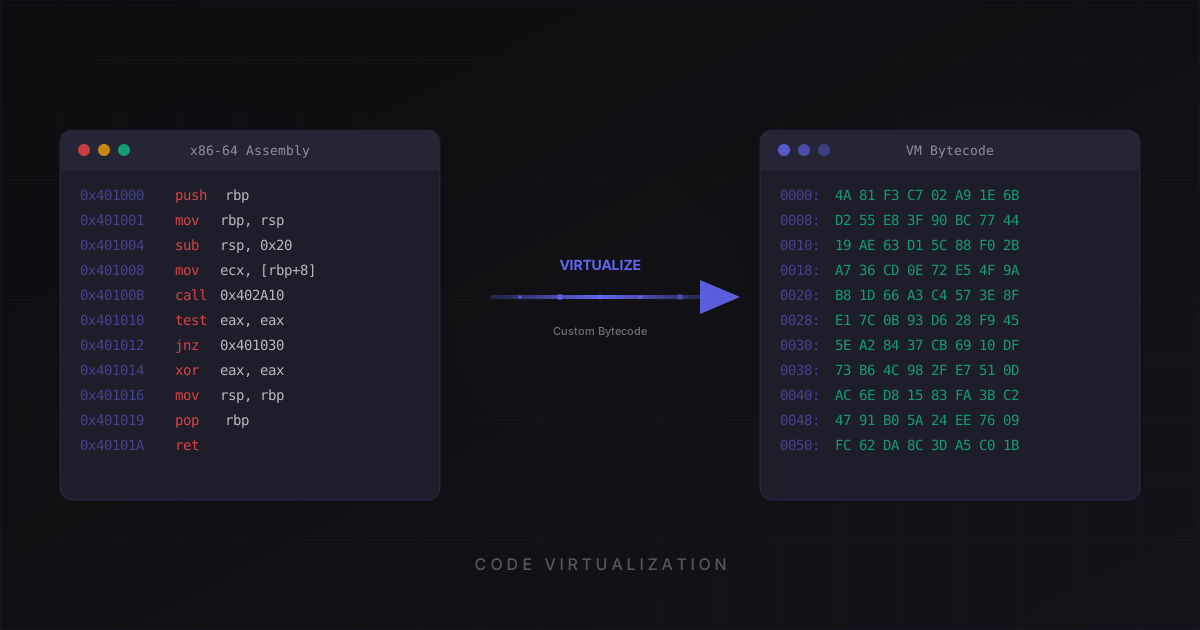
Code virtualization: Supported selected functions can be translated into custom bytecode executed by an embedded VM interpreter. Static tools do not initially have a native representation for that bytecode, but analysts can reverse the interpreter or observe execution. The benefit is increased analysis cost, not a guaranteed number of days or weeks.
String encryption: Supported printable C strings in eligible read-only sections can be encrypted and restored by an injected startup stub. Short, non-C, relocated or unsupported values can remain visible; verify coverage on the real binary.
Import obfuscation: Rewriting ELF PLT/dynamic-linker metadata is a separate technique, but it is not part of the current ChaosProtector Linux release. Do not infer Windows IAT-protection behavior on ELF.
Anti-debug via ptrace and TracerPid: Startup checks can detect common tracing states through PTRACE_TRACEME and /proc/self/status. They are useful signals but can be patched, intercepted or affected by container/security policy, so test the intended deployment environment.
Analysis metadata reduction: The current Linux release can strip section headers and randomize the GNU build ID. It does not claim the Windows anti-disassembly jump-chain as an ELF feature.
Integrity checks: The current x86-64 ELF stub verifies the configured .text range with its baked-in rolling hash and terminates on a covered mismatch. This does not cover every file byte or runtime patch.
DWARF unwind emission for VM stubs: On Linux, exception handling and stack unwinding use .eh_frame and .debug_frame DWARF CFI records. If your protector relocates functions or injects VM trampolines, it must emit new DWARF unwind info so that C++ exceptions, longjmp, and signal handlers still walk the stack correctly. This is non-trivial and is why most ad-hoc Linux protection tools break when a protected function throws.
The ChaosProtector Linux ELF Pipeline
ChaosProtector supports Linux ELF64 binaries natively, sharing the same ChaosVM virtualization engine with the Windows PE build. The pipeline is:
# Inspect the functions and metadata available to the Linux protector
./chaosprotector-linux --list ./mybin

# Basic-safe preset plus virtualization of supported enumerated functions
./chaosprotector-linux ./mybin ./mybin.protected --all --vm

# Pro preset (review AntiVM/debug side effects before enabling extra flags)
./chaosprotector-linux ./mybin ./mybin.protected --max --vm
The protector validates the ELF layout, discovers functions and eligible read-only strings, and adds the sections or segments required by the selected transforms. VM coverage is conservative: unsupported native bridges, control flow or unwind semantics are skipped and reported instead of being forced.
The safe --all preset uses the TracerPid check. The separate --antidebug PTRACE_TRACEME option has documented signal, fork and non-TTY side effects; test it explicitly before using it in a daemon, CI runner, container or systemd service.
String encryption covers eligible printable C strings in .rodata-family sections. Integrity uses the Linux runtime's rolling .text hash. The current Linux release does not rewrite the PLT or provide the Windows IAT-protection feature.
Windows and Linux expose different protection sets and runtime tradeoffs. Compare the effective CLI report and test the exact output rather than assuming equivalent coverage.
When Linux Binary Protection Makes Sense
Not every Linux binary needs this. Open-source projects obviously do not. Build-time-only tools, internal scripts, and anything you distribute as source code are out of scope.
Linux binary protection makes sense when:
- You ship a closed-source Linux native build of a commercial game and want an ELF-specific hardening layer alongside the Windows release.
- You deploy a proprietary low-latency trading or HFT binary to customer colocation or cloud and cannot rely on network isolation alone.
- You ship a SaaS agent or sidecar inside customer infrastructure and want to raise the cost of casual inspection. A user with root remains outside the protection boundary.
- You sell industrial controller firmware, DRM enforcement daemons, or license validation agents that run on Linux appliances.
- Your Python or Rust application has been compiled to a native Linux binary and you want to evaluate the available ELF-specific transforms.
- You ship a licensed CLI tool and want to raise the effort required to patch a client-side license check while keeping decisive authorization on a server.
The common thread is that the binary holds something valuable (a key, an algorithm, a model, a license check) and ends up on a machine you do not control.
The Key Takeaway
Linux binaries are not automatically harder to reverse engineer. The tooling is widely available and the format is documented. If a Linux binary contains valuable client-side logic, consider selective virtualization, string encryption, anti-debug signals and integrity checks alongside server-side authorization. The current release does not include ELF import obfuscation.
strip and UPX do not provide a secrecy boundary. ChaosProtector adds Linux-specific ELF64 transforms, but they are not identical to the Windows PE pipeline and cannot make code running on a customer's machine unrecoverable.
If you ship a Linux binary and your code is worth protecting, start there.
Ready to protect your software?
Download ChaosProtector for free and start protecting your binaries in minutes.
Download Free