
How to Protect Go Binaries from Reverse Engineering in 2026
Go Binaries Are Not Opaque
Go compiles to native x86-64 machine code. Many developers assume this means their binaries are hard to reverse engineer. They're wrong.
Every Go binary contains a data structure called pclntab (the Program Counter Line Table). It maps every function address to its full package path, function name, source file path, and line numbers. This is used by Go's runtime for stack traces, panic recovery, and garbage collection.
Open any Go binary in IDA Pro or Ghidra. Without any debug symbols, you'll see every function neatly labeled: main.validateLicense, internal/auth.CheckAPIKey, pkg/crypto.DecryptPayload. File paths reveal your project structure. String literals expose API endpoints, error messages, and configuration keys.
This is not a theoretical risk. Tools like GoReSym by Mandiant parse pclntab automatically. RedNaga's go-re-tools do the same. A reverse engineer gets a near-complete map of your application in seconds.
Garble Is Losing the Arms Race
Garble is the most popular Go obfuscation tool. It works as a compiler wrapper, stripping and randomizing names at compile time. For a while, it was good enough.
Not anymore.
In 2025, Google released GoStringUngarbler, a tool that recovers original string literals from Garble-protected binaries. It exploits the fact that Garble's -literals flag uses predictable XOR patterns with keys embedded in the binary itself. The tool reconstructs strings automatically.
Volexity released GoResolver, which uses machine learning to recover original function names from Garble-obfuscated binaries. It matches control flow patterns against a database of known Go standard library functions. Even with names stripped, the function structure gives them away.
The Garble maintainer has openly discussed removing the -literals flag entirely because it provides a false sense of security. The feature was never designed to resist dedicated analysis.
Garble also breaks when Go internals change. Every major Go release risks compatibility issues because Garble hooks into the compiler toolchain. Go 1.22 broke several Garble features. Go 1.23 required weeks of patches. You're always one go get away from a broken build.
Why Source-Level Protection Fails for Go
Some developers try manual approaches: embedding encrypted strings, using build tags to strip debug info, or writing custom linker scripts. These don't scale and they don't work.
Go's runtime needs pclntab. Strip it completely and your binary crashes on the first panic, goroutine switch, or garbage collection cycle. The runtime walks pclntab constantly. You can corrupt it, but you can't remove it.
-ldflags="-s -w" strips DWARF debug info and the symbol table. This removes some metadata but leaves pclntab completely intact. Every function name and source path survives.
The core problem is that Go's toolchain doesn't support obfuscation as a goal. The compiler, linker, and runtime all assume metadata will be present and accurate. Fighting this at the source level is a losing battle.
Post-Compilation Protection: A Different Approach
ChaosProtector takes a fundamentally different approach. It operates on the compiled binary, after Go has finished its work. No compiler hooks. No source code changes. No build system modifications.
The workflow is simple:
go build -ldflags="-s -w" -o myapp.exe ./cmd/myapp
ChaosProtectorGui.exe --console -f myapp.exe --vm --strings --imports --integrity -o myapp.protected.exe
The first command builds a stripped Go binary. The second requests explicit Basic protection features; review the CLI coverage report and test the resulting executable before release.
What Happens Under the Hood
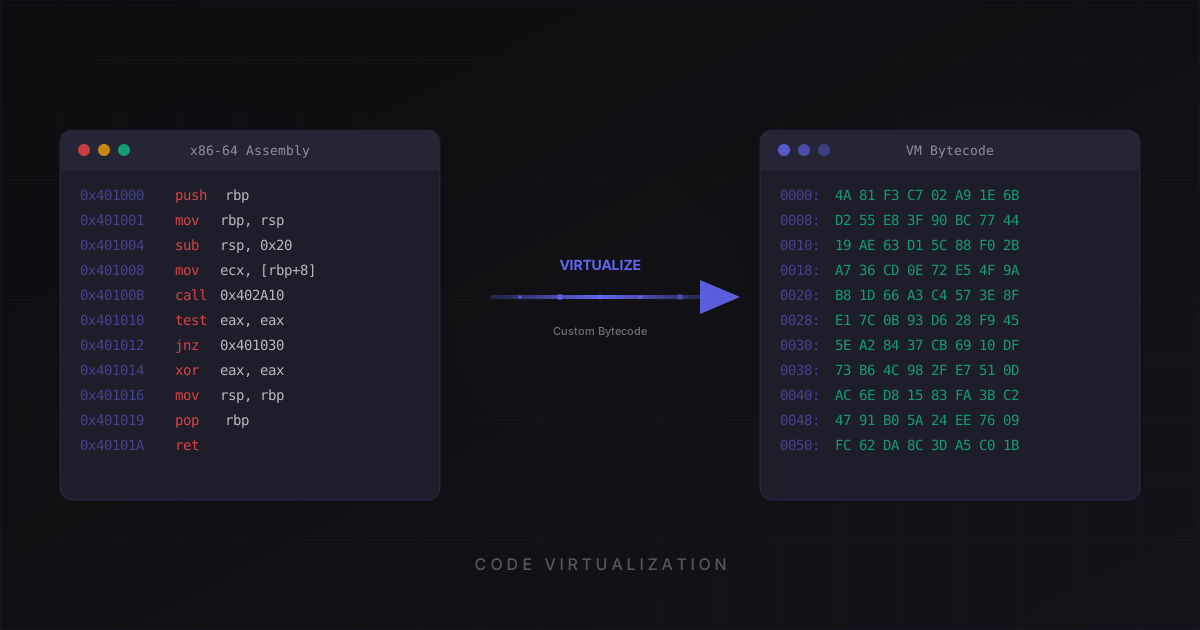
Code obfuscation applies compatible instruction substitutions, indirect-branch transforms and liveness-aware junk patterns. The result remains analyzable and the actual coverage depends on the emitted instructions.
String encryption covers supported referenced strings in the PE image and restores them at startup. Go metadata and unsupported string layouts can remain visible, so measure the actual reduction with the tools in your threat model.
Import protection reduces supported imports to a bootstrap and restores them with a PEB-based runtime resolver. Required bootstrap imports and calls observed at runtime remain visible.
Anti-debug adds base debugger-state checks; Pro adds more invasive hook, anti-dump and instrumentation checks. Determined analysts can still patch or bypass client-side checks.
Integrity checking verifies configured code regions and image invariants at startup. It detects covered modifications, not every possible runtime change.
Go-Specific Considerations
Go binaries have some unique characteristics that matter for protection.
Static linking: Go statically links much of its runtime, producing large binaries. Larger inputs increase analysis and rewrite cost; test representative production-sized binaries rather than assuming an unlimited size.
CGo binaries: If you use CGo, your binary has a conventional import table alongside the Go runtime. Supported entries can use import protection, but validate every native dependency.
pclntab: The Go runtime still needs pclntab. ChaosProtector does not claim to remove it; selected compatible functions may be transformed while metadata and unselected runtime code remain analyzable.
goroutines and GC: Select business functions rather than runtime internals. Then test goroutine scheduling, garbage collection, panic/unwind paths and CGo boundaries on the protected output.
Selecting What to Protect
You don't need to virtualize every function. Go binaries often contain thousands of functions from the standard library. Virtualizing all of them would slow your application and provide no real benefit.
Focus on:
- License validation and activation logic
- Proprietary algorithms and business rules
- API key handling and authentication flows
- Encryption and signing routines
- Anti-tamper checks
Leave standard library functions, HTTP handlers, and I/O operations unprotected. They're public code anyway.
The ChaosProtector dashboard lets you select functions by name or address. You can also use the CLI with a function list file for CI/CD integration.
Comparing Approaches
| Feature | Garble | -ldflags "-s -w" | ChaosProtector |
|---|---|---|---|
| Strip DWARF | Yes | Yes | N/A (post-compile) |
| Strip pclntab names | Yes | No | N/A (functions virtualized) |
| String encryption | Weak (XOR) | No | Strong (AES-level) |
| Code virtualization | No | No | Yes |
| Anti-debug | No | No | Yes |
| Integrity check | No | No | Yes |
| Survives GoStringUngarbler | No | N/A | Yes |
| Survives GoResolver | Partially | N/A | Yes |
| Build system changes | Required | Minimal | None |
Getting Started
Build your Go binary normally. Strip debug info with -ldflags="-s -w" for a smaller starting point. Then run ChaosProtector on the output.
Test the protected binary thoroughly. Go's test suite can't run on the protected binary directly (it's a different executable), so use integration tests or end-to-end tests that exercise the protected code paths.
Start with string encryption and import protection. These have zero performance impact and block the most common analysis techniques. Add code virtualization to your most sensitive functions once you've verified everything works.
Check pricing for the plan that fits your needs. The free tier includes string encryption. Pro adds code virtualization, anti-debug, and integrity checking.
ChaosProtector works on any Go binary without source code changes. Build, protect, ship. Get started free.
Ready to protect your software?
Download ChaosProtector for free and start protecting your binaries in minutes.
Download Free